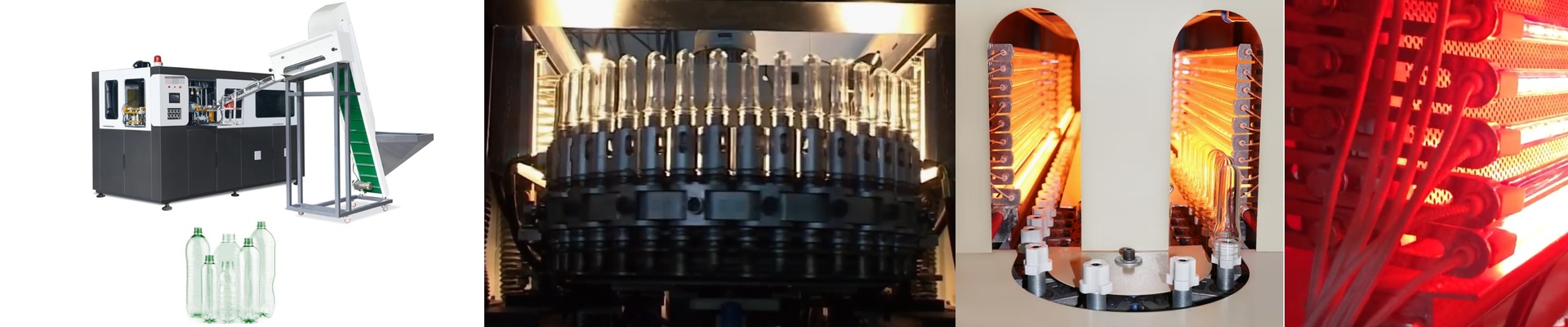

Out on the blow molding line, the heating tunnel is where the day gets made—or undone. You know the feeling. Preforms start drifting off temperature, and suddenly you’re chasing thin spots, crystallization, or stretch that’s all over the map. Sometimes the lamp output has dropped. Sometimes the reflector has lost its edge. Sometimes it’s just enough variance between lamps to throw the whole process out of balance. When the heater lamp underperforms, the blow molder doesn’t just slow down—it starts burning material, energy, and time. We build OEM-spec heater lamps to stop that drift where it starts. Match the electrical and mechanical interface so the lamp behaves like the original, and tune the infrared spectrum to heat PET preforms the way your stretch blow molding process expects.
What actually matters under the hood
Blow molding heater lamps aren’t just heat sources. They’re engineered components that have to deliver repeatable power density, stable spectral output, and predictable thermal behavior in a crowded heating tunnel. We supply infrared heater lamps in the configurations most common on blow molders:
- Halogen quartz lampsfor fast response with tight control over short-wave output.
- Short-wave infrared (IR) emitter lampsfor rapid, high-intensity energy delivery.
- Medium-wave infrared optionswhen you want slightly deeper penetration. The specs we hold to are the ones that hit uptime and bottle quality:
- Wattage and voltagematched to your machine’s heating zone design (typical ranges include 1000–4000 W, 100–240 V, depending on the model).
- Dimensions and arc lengthmatched to the original lamp so the hot zone stays aligned with the preform wall.
- Connector typematched to the OEM interface—commonlyR7s, but alsoG38,G18, and other high-temperature ceramic terminals depending on the blow molder.
- Reflector integrationmatched to the lamp’s end cap and overall length, so the reflector sits where it should and directs energy where it needs to go.
- Filament design and quartz qualitychosen for stable output over long duty cycles and resistance to thermal shock inside the tunnel. Why does this matter? Preform heating lives in a narrow window. If lamp output drifts or geometry changes the energy distribution, the preform temperature profile shifts—and then you get uneven stretch, weak shoulders, or hazing.
Why this works in the real world
In stretch blow molding, the heating tunnel is a system: lamps, reflectors, airflow, and sensor feedback all work together to hit a target temperature profile. Swap in a non-spec lamp and you can still get heat—but you lose repeatability. We design our OEM blow molding machine heater lamps to behave like the original, so you can replace lamps without re-engineering the heating process. What that means on the floor:
- **Stable preform heating.**Matched output reduces lamp-to-lamp variance, so the temperature band stays tight and the blow stage behaves predictably.
- **Fewer process excursions.**Consistent heating cuts rejects tied to off-temperature preforms—less scrap, less rework, fewer stops to “tune” the tunnel.
- **Faster changeovers.**With the right interface and dimensions, the lamp installs the way it should, and the heating zone comes back to target quickly after the change.
- **Better energy use.**Infrared lamps deliver heat straight to the preform surface, and when the lamp is spec-matched, you aren’t wasting energy compensating for weak spots, misaligned reflectors, or uneven output. These lamps are built for the realities of blow molding: repeated thermal cycling, tight spacing inside the tunnel, and the need to run long hours without constant adjustment.
The practical details that save you headaches
Not every heating tunnel is set up the same, and not every replacement is plug-and-play. Here are the points that matter when you’re standing at the machine. **Compatibility comes down to part numbers.**Same wattage does not guarantee fit. Lamp length, base, connector, and reflector interface must match your machine. Give us the blow molder model and the lamp part number you’re replacing, and we’ll match the critical interface dimensions and electrical spec. **Reflectors matter as much as the lamp.**Put a fresh lamp in a worn reflector and you can still get uneven heating. If the reflector surface has oxidized or the alignment has shifted, the lamp can be perfect and the result still disappointing. Replace or recondition reflectors on the same schedule. **Power density is adjustable—but not infinite.**If you need to change heating intensity, do it the right way: match the lamp spec and adjust dwell time or power input within the machine’s design limits. Pushing a lamp beyond its rated voltage or using the wrong geometry to “force more heat” shortens lamp life and increases variance. **Installation needs clean, careful handling.**Quartz and ceramic parts are tough, but they’re sensitive to contamination and mechanical stress. Keep terminals clean, don’t over-torque, and make sure the lamp is fully seated in the holder. A poor contact causes arcing and heat at the connection, which can damage the terminal and cost you downtime. If you’re running Sidel, Krones, SIPA, Husky, SACMI, Nissei ASB, or other blow molding platforms, we can supply the OEM-matched heater lamp that meets the machine’s interface and your production demands—so the heating tunnel keeps doing its job, shift after shift.