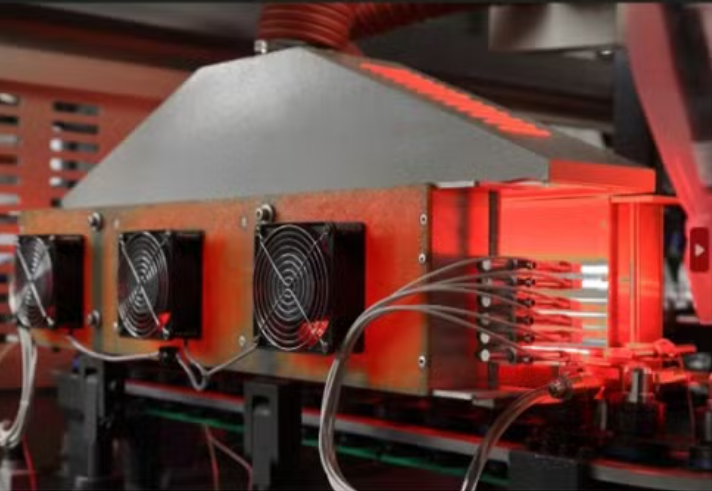
On the floor, a mismatched heater doesn’t just throttle the line. It throws preforms off their thermal profile, and the bottles show it immediately. Stretch blow molding doesn’t forgive sloppy heating. If the infrared output, lamp geometry, and response time aren’t dead-on with the machine’s original design, you’re going to see uneven wall thickness, crystallization, and material going straight into the scrap bin.
What matters, technically
We build PETC and PET preform infrared radiators to match OEM specs 1:1 for Sidel, Krones, SIPA, Husky, SACMI, and Nissei ASB blow molders. Typical quartz and halogen setups run 2400–3600 W, 220–240 V, with 100–180 mm arc lengths and R7s connectors. They deliver 0.8–1.2 µm wavelength for fast, targeted heating. Emitter response sits at 1–2 seconds, so the heating tunnel stays in step with your timing. We match power density and spectral output to the original lamp, keeping the thermal profile stable across the preform neck and body.
Why this works in practice
When the parameters line up 1:1, you keep the same heating curve without retuning the whole blow molder. That means fewer scrap bottles, more consistent top-load performance, and cycle times that don’t wander. Energy use drops because the emitter puts heat where it’s needed. Lamp life holds steady at 5000–7000 hours under normal conditions, so unplanned stops come down. Replacement is straightforward: same wattage, same dimensions, same connector.
The things to keep straight
Installation is plug-and-play when the lamp length, terminals, and mounting match the OEM. Before you restart, double-check reflector alignment and tunnel airflow. These emitters don’t like oil and dust. Wipe quartz tubes with a clean, dry cloth, and don’t touch the surface. If your blow molder runs extended cycles, confirm the voltage tolerance at the socket—voltage drift will shorten lamp life. We supply the exact specs so you can cross-check against your machine before you order.